# Divergence and Curl of Vector Fields (DC-VF)
> Vector fields allow us to understand the invisible "flow" governing space by analyzing how vectors change between points to describe complex physical phenomena like fluid currents and atmospheric expansion. This analysis focuses on two primary characteristics: divergence, which measures "source" or "sink" behavior through expansion or compression, and curl, which describes the rotational tendency or "spin" of the field. Key archetypes illustrate these concepts, such as source fields that exhibit pure radial outward flow with positive divergence and rotational fields that display circular motion with zero expansion but constant spin. To bridge the gap between abstract mathematics and physical intuition, quiver plots map the field's strength and direction using arrows, while particle simulations provide dynamic animations that track movement frame-by-frame. Interactive tools further enhance this understanding by using boundary handling to maintain continuous visual flow, making it easier for observers to distinguish between expanding sources and swirling vortices in real-time.
### :scarf:Example-to-Demo
Description
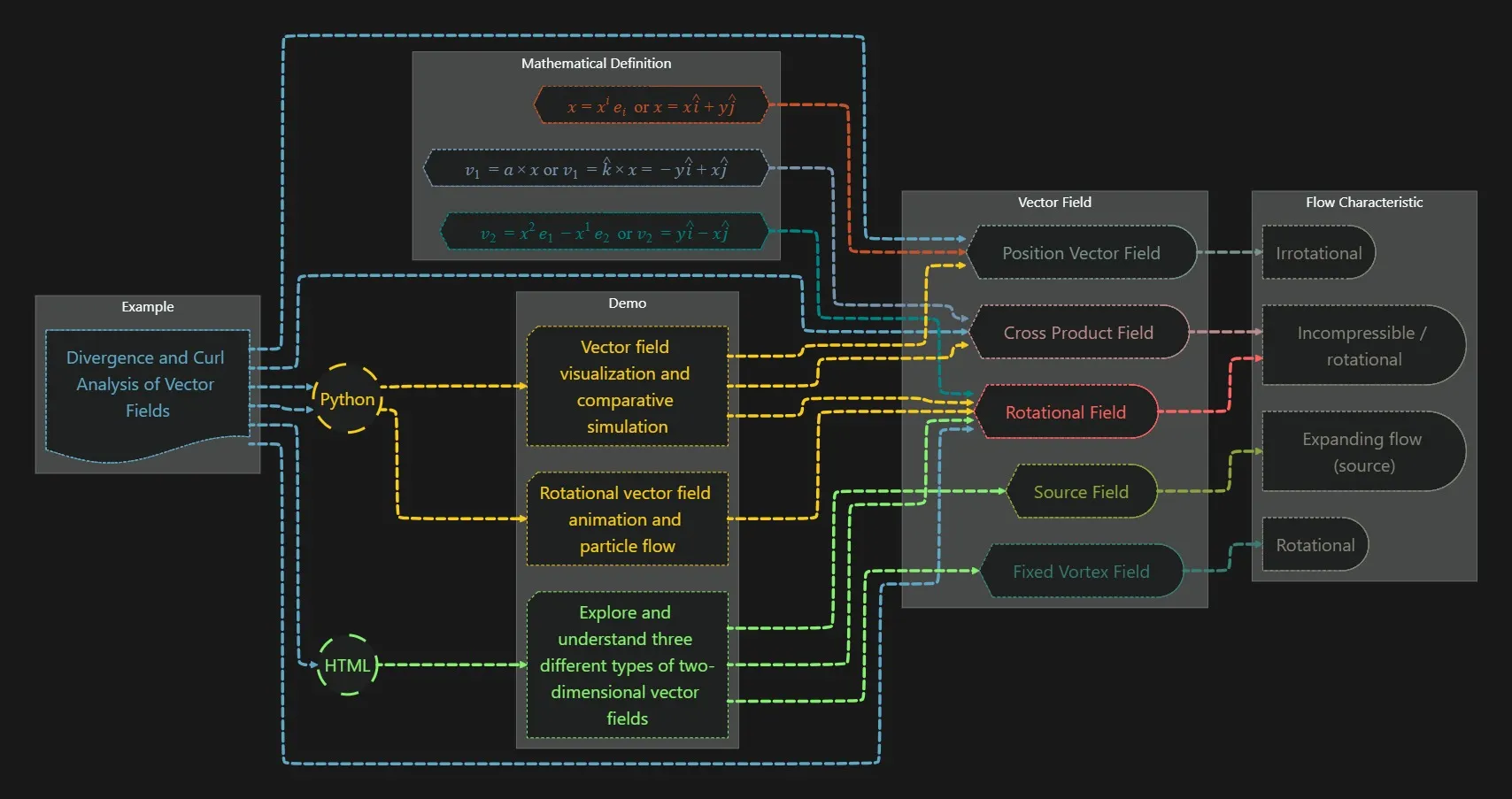
This flowchart illustrates a comprehensive workflow for the **Divergence and Curl Analysis of Vector Fields**. It maps the journey from mathematical theory to digital demonstration and final physical interpretation.
The diagram is organized into five primary vertical blocks, moving generally from left to right.
#### **1. The Starting Point (Example)**
The flowchart begins with a high-level conceptual box titled **Example**, which focuses on the core topic: "Divergence and Curl Analysis of Vector Fields." This serves as the anchor for all subsequent branches.
#### **2. Implementation Medium (Python & HTML)**
The analysis is split into two technological paths:
* **Python:** Primarily handles the visualization and animation of complex particle flows.
* **HTML:** Focuses on the interactive exploration of three distinct types of 2D vector fields.
#### **3. Demos and Mathematical Definitions**
This section bridges the gap between code and calculus.
* **Demos:** Includes "Vector field visualization," "Rotational vector field animation," and "Interactive 2D field exploration."
* **Mathematical Definitions:** This top-center block provides the formal logic for the fields:
* **Position:** $$\mathbf{x} = x\mathbf{\hat{i}} + y\mathbf{\hat{j}}$$
* **Cross Product:** $$\mathbf{v}\_1 = \mathbf{a} \times \mathbf{x} = -y\mathbf{\hat{i}} + x\mathbf{\hat{j}}$$
* **Specific Vector Mapping:** $$\mathbf{v}\_2 = y\mathbf{\hat{i}} - x\mathbf{\hat{j}}$$
#### **4. Vector Field Categorization**
The definitions and demos feed into specific **Vector Field** types:
* **Position Vector Field:** Linked to irrotational flow.
* **Cross Product Field:** Linked to rotational/incompressible flow.
* **Rotational Field:** Specifically highlighting the curl aspect.
* **Source Field:** Linked to the "expanding" nature of divergence.
* **Fixed Vortex Field:** Another variation of rotational movement.
#### **5. Flow Characteristics (The Results)**
The final block on the right summarizes the physical properties of the fields analyzed:
* **Irrotational:** No "spinning" at any point.
* **Incompressible / Rotational:** Constant density, but with rotation.
* **Expanding Flow (Source):** Positive divergence.
* **Rotational:** Pure curl-based movement.
***
**Summary Table of Field Types**
| **Vector Field Type** | **Mathematical Basis** | **Flow Characteristic** |
| --------------------- | ---------------------- | ------------------------- |
| **Position** | Standard coordinates | Irrotational |
| **Source** | Divergence-heavy | Expanding flow |
| **Cross Product** | Perpendicular vectors | Rotational/Incompressible |
***
### :pushpin:Divergence and Curl Analysis of Vector Fields
Description
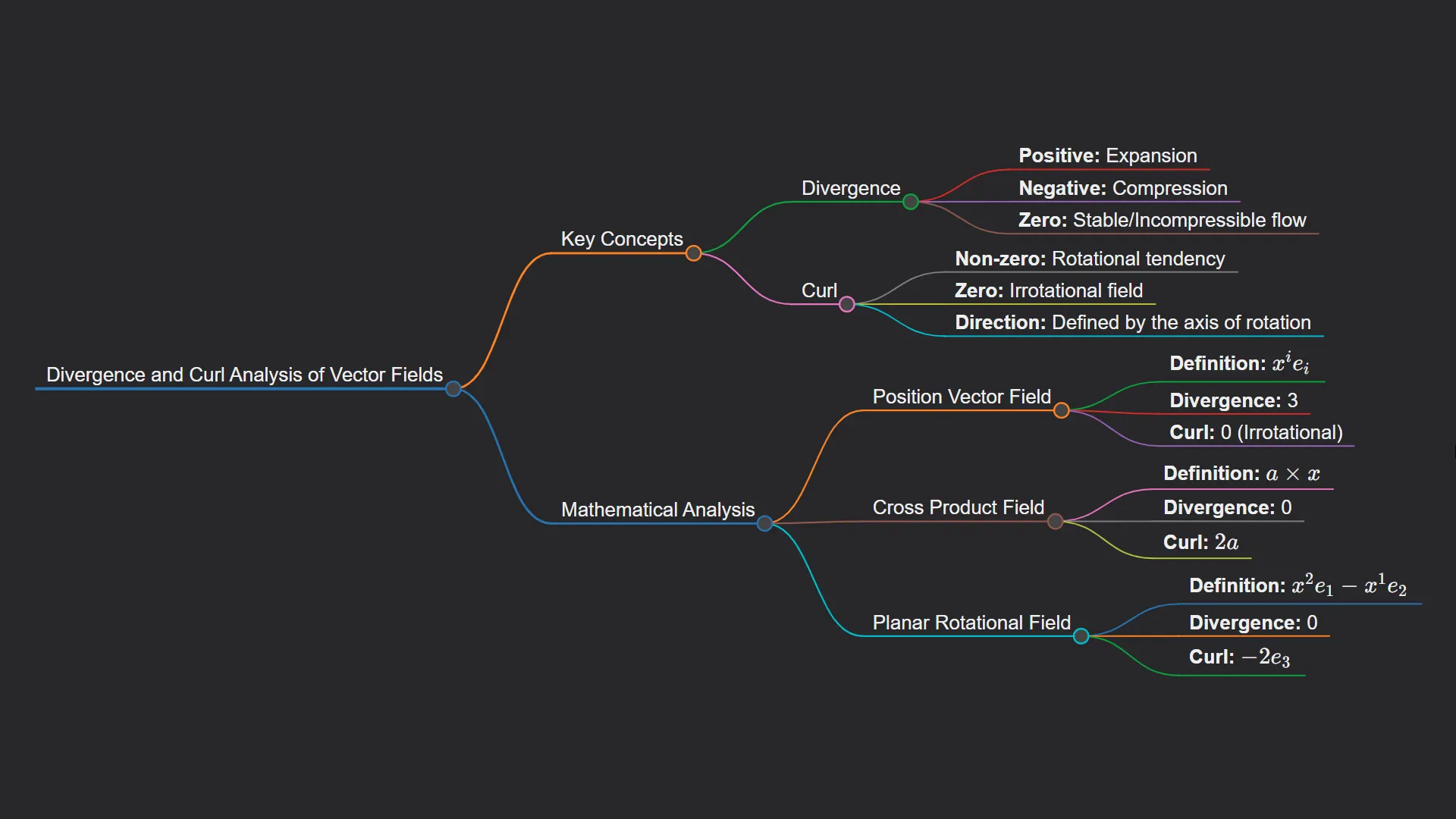
This mindmap provides a structured overview of the **Divergence and Curl Analysis of Vector Fields**, breaking the topic down into conceptual definitions and specific mathematical applications.
#### **Key Concepts**
The top branch defines the fundamental physical interpretations of divergence and curl:
* **Divergence:** Represents the flow behavior of a field.
* **Positive:** Indicates expansion.
* **Negative:** Indicates compression.
* **Zero:** Represents stable or incompressible flow.
* **Curl:** Represents the rotational nature of a field.
* **Non-zero:** Indicates a rotational tendency.
* **Zero:** Defines an irrotational field.
* **Direction:** Defined by the axis of rotation.
#### **Mathematical Analysis**
The bottom branch applies these concepts to three specific types of vector fields:
| **Field Type** | **Definition** | **Divergence Value** | **Curl Value** |
| --------------------------- | ----------------------- | -------------------- | ---------------- |
| **Position Vector Field** | $$x^i e\_i$$ | 3 | 0 (Irrotational) |
| **Cross Product Field** | $$a \times x$$ | 0 | 2a |
| **Planar Rotational Field** | $$x^2 e\_1 - x^1 e\_2$$ | 0 | $$-2e\_3$$ |
***
### :clapper:Narrated Video
{% embed url="" %}
### :thread:Related Derivation
{% content-ref url="../proof-and-derivation/divergence-and-curl-analysis-of-vector-fields-dca-vf" %}
[divergence-and-curl-analysis-of-vector-fields-dca-vf](https://via-dean.gitbook.io/all/~/revisions/WYsapCOkHSgcDPhymfq8/multifaceted-viewpoint/mathematical-structures-underlying-physical-laws/proof-and-derivation/divergence-and-curl-analysis-of-vector-fields-dca-vf)
{% endcontent-ref %}
### :hammer\_pick:Compound Page
{% embed url="" %}