# How the Cross Product Relates to the Sine of an Angle (CP-SA)
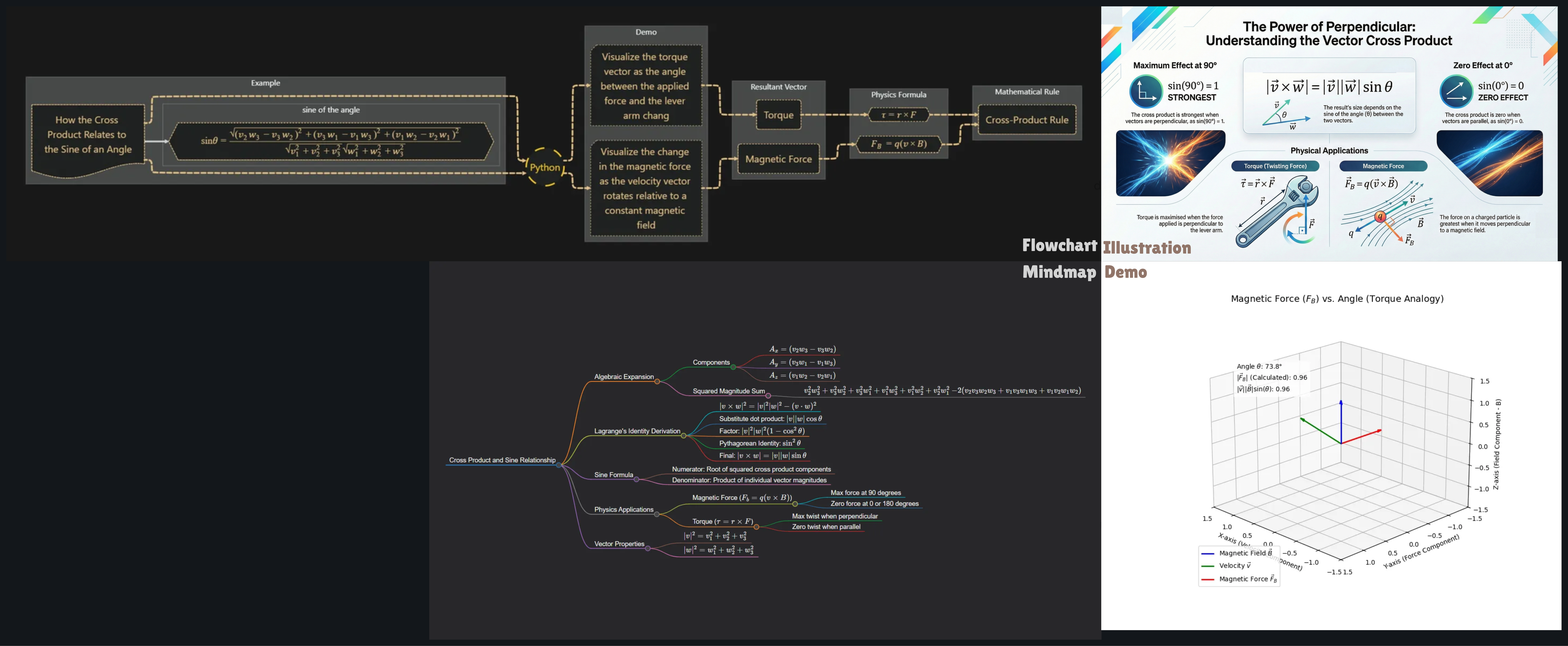
> The relationship between the cross product and the geometry of two vectors reveals that the magnitude of their vector product is intrinsically linked to the area of the parallelogram they span. By expanding the squared magnitude of the cross product $$|v \times w|^2$$ into its Cartesian components, we can algebraically prove Lagrange's Identity, which demonstrates that this value is equivalent to the difference between the product of the squared magnitudes $$|v|^2|w|^2$$ and the square of the dot product $$(v \cdot w)^2$$. Consequently, by substituting the trigonometric identities for the dot and cross products into this relationship, we derive that the sine of the angle $$\theta$$ between the vectors is the ratio of the magnitude of the cross product to the product of the individual magnitudes. This provides a direct method to determine the angular orientation of vectors in 3D space using only their algebraic components.
### :clapper:Narrated Video
* Demo
{% content-ref url="../animated-results/how-the-relationship-between-the-cross-product-and-the-geometry-of-two-vectors-applies-in-physics-to" %}
[how-the-relationship-between-the-cross-product-and-the-geometry-of-two-vectors-applies-in-physics-to](https://via-dean.gitbook.io/all/~/revisions/WYsapCOkHSgcDPhymfq8/multifaceted-viewpoint/mathematical-structures-underlying-physical-laws/animated-results/how-the-relationship-between-the-cross-product-and-the-geometry-of-two-vectors-applies-in-physics-to)
{% endcontent-ref %}
### :paperclip:IllustraDemo
* Illustration
{% content-ref url="../illustrademo/cross-product-torque-and-magnetic-force" %}
[cross-product-torque-and-magnetic-force](https://via-dean.gitbook.io/all/~/revisions/WYsapCOkHSgcDPhymfq8/multifaceted-viewpoint/mathematical-structures-underlying-physical-laws/illustrademo/cross-product-torque-and-magnetic-force)
{% endcontent-ref %}
### :scarf:Example-to-Demo
* Flowchart and Mindmap
{% content-ref url="../example-to-demo/the-sine-relationship-of-the-vector-cross-product-sr-vcp" %}
[the-sine-relationship-of-the-vector-cross-product-sr-vcp](https://via-dean.gitbook.io/all/~/revisions/WYsapCOkHSgcDPhymfq8/multifaceted-viewpoint/mathematical-structures-underlying-physical-laws/example-to-demo/the-sine-relationship-of-the-vector-cross-product-sr-vcp)
{% endcontent-ref %}
### :maple\_leaf:The Vector Cross Product moving from its complex algebraic roots to its essential role in physics
Description
#### **1. Mathematical & Algebraic Foundation**
The documentation establishes that the cross product is inextricably linked to the **sine of the angle** ($$\theta$$) between two vectors.
* **Component Calculation:** The cross product is calculated using specific vector components ($$A\_x, A\_y, A\_z$$).
* **The Sine Formula:** The relationship is expressed as $$|\vec{v} \times \vec{w}| = |\vec{v}||\vec{w}| \sin\theta$$.
* **Lagrange’s Identity:** The mindmap derives this relationship by using the dot product ($$|v||w| \cos\theta$$) and the Pythagorean Identity to prove that the cross product magnitude represents the "perpendicular" component.
#### **2. The "Power of Perpendicular" Principle**
The central theme across these images is how the angle $$\theta$$ dictates the magnitude of the result.
* **Maximum Effect (90°):** When vectors are perpendicular, $$\sin(90^\circ) = 1$$, resulting in the strongest possible cross product.
* **Zero Effect (0°/180°):** When vectors are parallel or anti-parallel, $$\sin(0^\circ) = 0$$, meaning the cross product (and its resulting physical force) disappears entirely.
#### **3. Real-World Physics Applications**
The flowchart and illustration translate these abstract math rules into two primary physical phenomena:
* **Torque (**$$\tau = r \times F$$**):** Known as "Twisting Force," it is maximized when you pull perpendicular to a lever arm, like a wrench.
* **Magnetic Force (**$$F\_B = q(v \times B)$$**):** The force exerted on a charge is greatest when its velocity is perpendicular to the magnetic field lines.
#### **4. Tools for Visualization**
The flowchart highlights that these relationships—specifically the way torque and magnetic force change as vectors rotate—can be modeled and visualized using **Python**. This allows for dynamic "demos" that show the resultant vector growing or shrinking based on the angle.
***
### :hammer\_pick:Compound Page
{% embed url="" %}